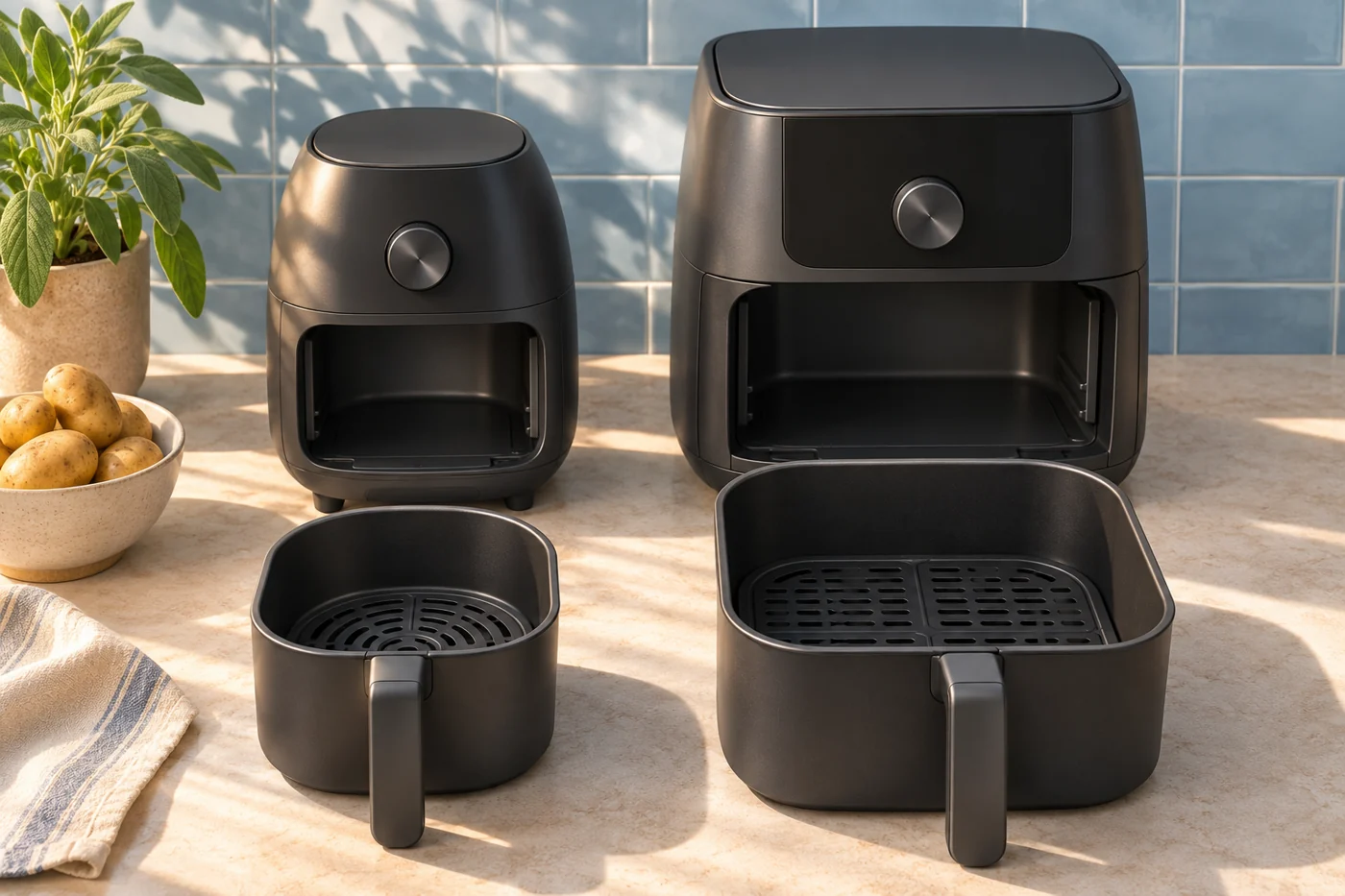
Put basket capacity ahead of presets. The AF101 suits a shortlist built around smaller batches; the TurboBlaze gives you more nominal capacity. Neither specification tells us which cooks your dinner better.
Comparison · No hands-on test claimedPicture a normal weeknight dinner, not the feast on the box. How much food needs to be ready together? How much of your counter can stay occupied? Those questions make this comparison more useful than a contest between feature counts.
Here we compare the US Ninja AF101 with the COSORI TurboBlaze CAF-DC601-KUS. Model codes matter: a familiar brand name can cover different baskets, coatings and control panels. This is a comparison of published specifications, not a cooking test.
The capacity difference is real. The serving claim needs context.
Ninja lists a 4-quart basket; COSORI lists 6 quarts. That makes the latter’s stated volume 50% larger. It does not establish 50% more usable cooking surface, or prove that either machine can finish a particular meal in one batch.
Our buying rule is to list the food you actually want to cook at once. A pair of flat portions asks something different of a basket than a pile of small pieces. Ask for basket-floor measurements if the listing only supplies volume. A capacity number cannot answer a shape question.
Controls are worth more when you will use them.
The AF101 lists four manual programs. TurboBlaze’s published temperature range is 90–450°F; Ninja’s advertised range is 105–400°F. The wider range creates options on paper. It is not evidence of steadier temperatures, better browning or a more accurate thermostat.
Before paying extra for functions, name the two or three jobs the appliance will do. If the answer is reheating leftovers and preparing simple sides, an unfamiliar control sequence every evening can matter more than an extra mode you never select.
Measure the whole routine.
Counter space is not just the appliance’s resting footprint. You also need room to open the drawer, set a hot basket down safely and follow the clearance instructions in the exact model’s manual. A machine that technically fits a shelf may still be awkward in use.
Make a paper template using the manufacturer’s exterior dimensions. Place it where the appliance would live and act out the drawer movement. This is a planning exercise, not a substitute for the manufacturer’s installation and safety instructions. Also check whether the basket fits your sink and usual drying space.
What would change our recommendation?
If the smaller unit means repeatedly cooking a second batch, extra capacity becomes more valuable. If the larger appliance will live in a cupboard because it crowds the counter, the nominal capacity advantage loses some of its appeal. Neither outcome can be decided from the star average.
We would want comparable cooking tests, a documented noise measurement and a review sample tied to these exact US models before naming a performance winner. Those data are not part of this article. There is deliberately no overall score.
Our practical conclusion: shortlist by batch size and kitchen fit, then compare the current delivered price and return terms. A cheaper price is only useful if the appliance fits the meals and space you have. For a broader checklist, read our air fryer size guide.
Reasons to consider
- AF101: smaller stated basket capacity may fit a small-batch routine.
- TurboBlaze: more nominal capacity and a wider published temperature range.
Trade-offs to weigh
- No first-hand cooking, noise or durability measurements here.
- Published quart capacity does not reveal usable basket-floor area.
| What matters | Ninja AF101 | COSORI TurboBlaze CAF-DC601-KUS |
|---|---|---|
| Basket volume | 4 qt | 6 qt |
| Published temperature range | 105–400°F | 90–450°F |
| Rated power | 1,550 W | 1,725 W |
| US supply | 120 V | 120 V, 60 Hz |
| Useful starting question | Will small batches cover your meal? | Will the larger unit fit your routine? |
| RealSeller performance score | Not assigned: no hands-on test | Not assigned: no hands-on test |
Sources & research notes
Desk research using the primary sources below. We have not physically tested these products or collected a representative owner-review sample. Specifications support feature comparisons, not performance or reliability scores.
Source check: 2026-11-12. Prices, availability and seller policies can change. Read our methodology.
Useful for your next purchase?